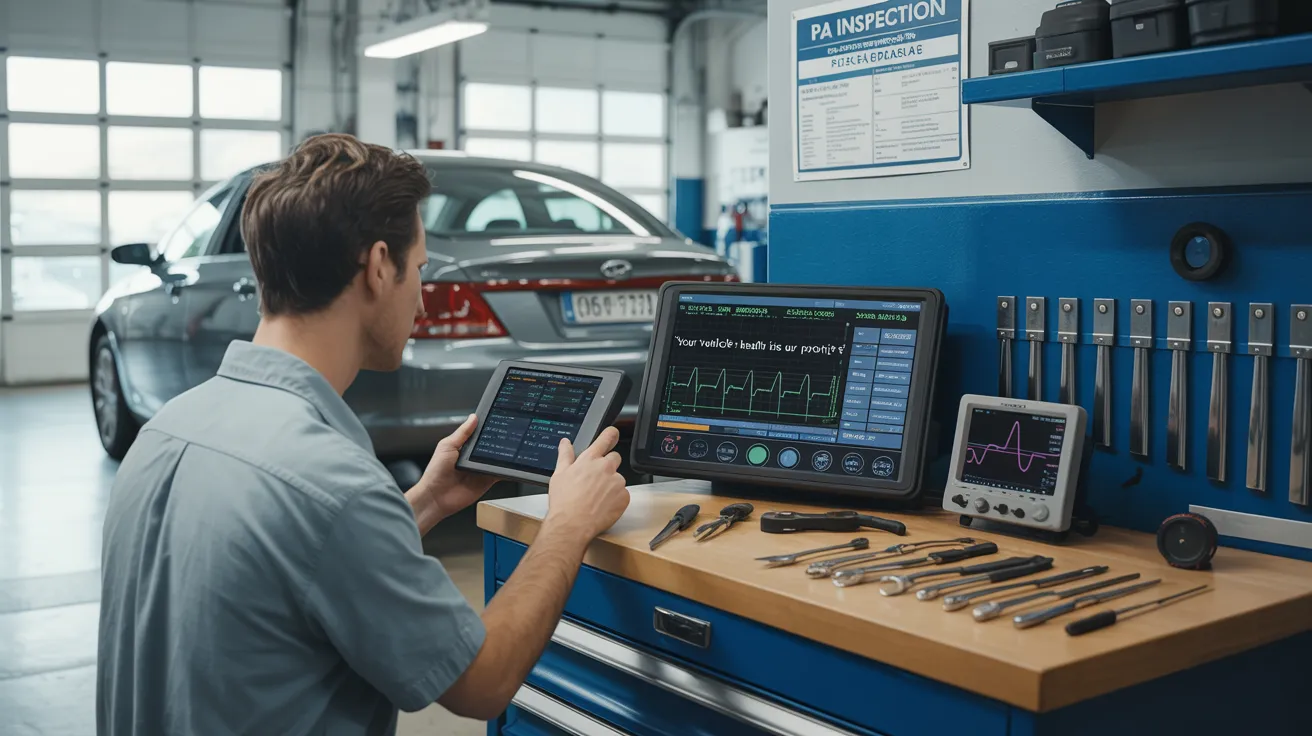
Seeking dependable auto repair in Reading, PA? Select local ASE-certified techs who are familiar with PA inspection requirements, road salt impact, and area driving. They scan modules, verify freeze-frame data, perform smoke tests, and use bi-directional controls to fix it right the first time. Count on accurate brake, suspension, and steering examinations, OEM-grade parts where safety counts, and transparent estimates with written warranties. Reduced travel provides quick follow-ups after updates or repairs. Continue reading to see how to identify issues and compare shops.
Core Insights
- Pick a local Reading PA shop for speedier diagnostics, simpler follow-ups, and compliance with Pennsylvania inspection requirements.
- Seek out ASE-certified technicians utilizing OEM-grade scan tools, oscilloscope testing, and smoke/pressure diagnostics for precise repairs.
- Confirm trustworthiness using independent reviews, professional certifications, Better Business Bureau ratings, and strong customer referrals.
- Look for transparent written estimates, required approval for alterations, and a written warranty detailing coverage, labor inclusion, and the claims process.
- Confirm that services include detailed road-testing, brake/suspension checks, alignments, and digital inspections with photos along with measured outcomes.
Why Selecting a Local Reading PA Mechanic Is Important
Choosing a nearby shop provides quicker diagnostic services, simpler follow-up visits, and reduced transportation expenses-major benefits when you choose a Reading, PA mechanic. You benefit from technicians who are familiar with local driving habits, road salt exposure, and Pennsylvania inspection standards, enabling targeted maintenance schedules and faster parts sourcing. Local partnerships with parts distributors minimize lead times and improve component traceability, while community involvement keeps shops accountable for craftsmanship and ethics.
You can evaluate capabilities directly through workshop tours, confirming equipment calibration, diagnostic tool range, and ASE certifications. Neighborhood outreach events commonly present brake lathe accuracy, alignment rack tolerances, and torque protocols, allowing you to confirm process discipline. With minimal commute, you can schedule repeated checks after software updates or repairs, guaranteeing systems relearn accurately and warranty terms remain upheld.
Warning Signs That You Need Professional Auto Repair
You ought to schedule professional service when warning lights turn on, especially the check engine, ABS, or airbag indicators. If unusual noises don't go away-such as grinding, knocking, squealing, or metallic rattles-these signal component wear or failure. Handling or braking issues, including pulling, vibration, soft pedal, or increased stopping distance, suggest safety-critical faults that call for immediate inspection.
Alert Lights Activate
At times, an illuminated dashboard light is your most obvious signal to schedule professional auto repair in Reading, PA. Modern dashboard indicators tie directly to control modules that monitor essential systems: engine, transmission, brakes, steering, and emissions. When a light comes on, you're seeing stored diagnostic trouble codes revealing sensor faults, software glitches, wiring issues, or component wear. Ignoring a MIL, ABS, or airbag light poses reduced performance or compromised safety.
It's important to document which lamp lit up and whether it's constant or flashing. A flashing MIL frequently indicates current misfire needing immediate attention. Technicians will conduct a scan, verify stored data, test circuits, and confirm operation with bi-directional controls. They will also eliminate lamp failures that mimic real faults. Prompt diagnosis avoids collateral damage, safeguards warranties, and restores proper system readiness.
Unusual Noises Persist
Frequently, ongoing noises—harsh metallic scraping, repetitive tapping, high‑pitched squealing, or continuous humming—suggest component deterioration that requires expert evaluation in Reading, PA. You should never ignore unusual sounds; they're warning indicators. A odd humming that changes with speed can point to irregular tread degradation, a deteriorating wheel bearing, or irregular tread pattern. Metallic grinding typically traces to belt-driven accessory or powertrain contact. Regular tapping might signal worn rod bearings, loose lifters, or a defective CV joint under load. Piercing squeals can stem from hardened drive belts or a improperly positioned pulley. Periodic clicking sounds commonly originates from lifter adjustment concerns, insufficient lubrication pressure, or debris contacting the cooling fan. Document when the sound occurs—engine cold, idle, speed increase, or after extended operation—and consult a experienced Reading mechanic before minor wear progresses.
Issues with Handling or Braking
Though unusual noises can suggest trouble, diminished handling or weak braking turns those hints into safety risks. If you notice a wheel shimmy at highway speeds, you may have out-of-balance tires, bent wheels, or worn suspension bushings. Pulling, increased steering effort, or a loose on-center feel can indicate failing tie rods, ball joints, or a misaligned front end. Under braking, pedal pulsation generally points to lateral runout or thickness variation in the rotors, occasionally caused by incorrect lug torque or overheated pads.
Longer stopping distances, a low or spongy pedal, and brake fade indicate air intrusion, fluid boil, or failing hydraulic components. Don't wait. A prompt inspection-road test, runout measurement, pad and tire assessmentreturns stability, decreases stops, and protects you and your passengers.
Key Upkeep Options to Extend Vehicle Life
To maximize vehicle longevity, you need a consistent plan for regular oil changes using the correct viscosity and OEM-grade filters. You should conduct tire rotation at defined mileage intervals to maintain even tread wear, proper alignment, and safe handling. You must also conduct brake system inspections, covering pads, rotors, fluid, and lines,to avoid fade, decrease stopping distance, and avoid costly repairs.
Regular Oil Service
Regular oil changes preserve your engine's bearings, rings, and valvetrain by maintaining proper lubrication, distributing heat, and transporting contaminants to the filter. You diminish varnish, sludge, and wear particles that hasten clearances and oil consumption. Follow your vehicle's oil life monitor or severe-service interval if you idle, tow, or drive short trips.
Select the viscosity grade listed on the oil cap or owner's manual. Top-grade synthetic oil fights oxidation, maintains film strength at elevated temperatures, and flows quickly at cold start, reducing startup wear. Always replace oil filters at each service; a high-quality filter with a durable media and anti-drainback valve ensures pressure and filtration efficiency. Check the drain plug torque and gasket condition, reset maintenance reminders, and log mileage and date.
Schedules for Tire Rotation
Commonly neglected yet vital, tire rotation balances tread wear resulting from drive-axle load, steering angles, and braking forces, increasing tire life and maintaining handling. Stick to a 5,000-7,500-mile schedule, or every oil change for severe service (limited-distance driving, heavy loads, frequent stops). Apply the rotation pattern recommended for your vehicle: front-wheel drive typically performs best with forward cross, rear-wheel and AWD from rearward cross; staggered or directional tires call for side-to-side or same-direction swaps.
Confirm inflation, torque lug nuts to spec, and reset TPMS after each service. Examine tread depth with a gauge and identify cupping or feathering that signals the need for seasonal alignment. Routine schedules decrease long term wear, maintain even contact patches, decrease noise, and ensure predictable traction in Reading's different road conditions.
Brake System Examinations
Though even tire wear keeps handling consistent, stopping power depends on a brake system that's checked on schedule and assessed against spec. You should verify pad thickness with a micrometer, compare rotor thickness and runout to manufacturer tolerances, and examine caliper slide freedom. Examine pad wear indicators for contact noise or sensor alerts, then verify even pad imprinting across rotor faces. Inspect brake hoses for swelling, corrosion at fittings, and leaks. Check the master cylinder for pedal hold and bypass. Measure fluid moisture content with a refractometer or conductivity tester, and execute brake fluid flushing when levels exceed spec or boiling points drop. In conclusion, road-test for pulsation, pull, and ABS activation thresholds to confirm hydraulic balance and control.
Expert Check Engine Light Analysis and Solutions
What's the process to identify the underlying issue behind a stubborn check engine light without guesswork? You begin with data. We attach professional scan tools to obtain manufacturer-specific DTCs, freeze-frame data, and live PIDs, then align them with fuel trims, misfire counters, O2 sensor waveforms, and CAN traffic. Next, we run guided fault tests— smoke tests for EVAP leaks, bidirectional controls for actuator verification, and scope-based circuit analysis to detect intermittent faults.
We also leverage remote telemetry to track sensor operation under real-world demands, enabling pattern recognition that exceeds a quick road test. After repairs, we validate emission calibration integrity, clear monitors, and conduct drive-cycle completion to ensure readiness. You leave with a documented root cause, validated fix, and a light that won't return.
Brake, Suspension, and Steering Repairs You Can Depend On
Reliably stopping, navigating curves, and running straight relies on a matched system: brake fluid systems and friction elements, suspension design and bushings, and steering components and assist. You want consistent braking bite, linear pedal response, and stable chassis performance. We verify pad thickness, rotor runout, and caliper slide freedom, then inspect hydraulic lines for corrosion, expansion, or leaks. We adhere to factory bleeding processes to remove microbubbles that produce fade and long pedal travel. For suspension, we evaluate ride height, bushing condition, ball joint play, and shock damping. After component replacement, we execute precise wheel alignment to return camber, caster, and toe. Steering systems get tie rod end, rack, and pump inspections, plus proper torque fasteners. The result is reliable deceleration, confident turn-in, and linear stability.
Motor and Transmission Expertise in Reading PA
You benefit from advanced diagnostics that isolate engine and transmission faults with OEM-grade scanners, live data, and pressure/vacuum tests. Skilled technicians interpret freeze-frame data, misfire counters, and adaptation values to pinpoint root causes, not just symptoms. When required, you get accurate transmission rebuild services-teardown, specification inspection, replacement of worn seals and clutches, valve body fine-tuning, and verification on a test drive and diagnostic scan.
Sophisticated Diagnostic Capacity
Locate faults with greater speed with state-of-the-art diagnostics that integrate OEM-grade scan tools with comprehensive testing by ASE-certified technicians in Reading, PA. You'll benefit from detailed fault-code interpretation, bidirectional control tests, and live data analysis that identify root causes—not surface issues. We cross-reference freeze-frame data, misfire counters, fuel trims, and mode 6 results to validate findings before any repair.
Our data-driven diagnostic services combine oscilloscope waveform capture, smoke testing, and pressure transducer analysis to confirm mechanical, electrical, or software issues. We execute network topology analyses on CAN, LIN, and FlexRay to fix intermittent communication faults. We provide software updates, relearns, and calibrations completed to manufacturer specs.
We additionally employ predictive maintenance insights derived from trend data-battery conductance, ignition patterns, oil condition, and thermal profiles-to foresee failures and decrease downtime.
Gearbox Rebuild Services
When a transmission slips, shudders, or sets ratio read more and pressure codes, our Reading, PA team tears down, inspects, and rebuilds the unit to OEM specs with precise calibration. We gauge every clutch pack, verify endplay, and blueprint clearances. You receive new frictions, steels, bushings, seals, and updated valve body calibrations. We swap out worn solenoids, ream bores when necessary, and confirm pump volume. Hard parts are magnafluxed; fatigued components are replaced with OEM or vetted remanufactured cores.
We don't make assumptions about fluids-we validate fluid compatibility for ATF, CVT, and DCT units and install the correct adaptive learn. Following assembly, we conduct pressure tests on circuits, set line rise, and road-validate shift timing and TCC apply. You'll receive a documented build, warranty coverage, and restored drivability.
Clear Rates, Warranties, and Customer Protection
Even though repair quality is important, clear pricing and strong guarantees build trust in Reading PA's auto shops. You should expect written estimates that list labor hours, diagnostic fees, shop supplies, taxes, and line-item parts costs-evidence of pricing transparency. Revisions require your approval before work continues. Reputable shops publish labor rates, honor flat-rate manuals, and document any sublet services.
Ask for warranty terms in writing: coverage period (duration in months/miles), included components, labor inclusion, national coverage validity, and claim protocols. Confirm exclusions, transferability, and prorated conditions. Select shops that provide digital inspections with images, torque specifications, and test results that confirm repairs.
Service agreements need to specify completion timeframes, drive-test verification, and follow-up inspections. You deserve transparent escalation channels, factory-compliant protocols, and a specific liaison for swift updates and problem-solving.
Original Equipment Manufacturer vs. Aftermarket Parts: What's Best for Your Car
Navigate the complexity by clarifying your options: OEM parts correspond to your car's original specifications, while aftermarket parts vary from equivalent replacements to performance upgrades from third-party manufacturers. When you opt for OEM, you get factory parts manufactured to the exact tolerances, materials, and calibration your vehicle was built with-perfect for retaining factory performance and emissions compliance. Aftermarket parts differ: reputable brands equal or beat OEM standards, while inferior components can cause fitment issues, noise, or accelerated wear.
Complete a cost comparison by weighing part price, longevity, and labor. A lower-cost component that fails early costs more once you add repeat labor and downtime. Consider warranty alignment, availability, and criticality: use OEM for safety systems, complex electronics, and newer vehicles; choose top-grade aftermarket for wear items like brakes, filters, and suspension.
The Way to Evaluate Reputation: Reviews, Certifications, and Referrals
Typically, you'll assess an auto shop's reputation by comparing reviews, certifications, and referrals. Start with third-party reviews: filter by vehicle type, repair category, and date to identify consistent patterns, not outliers. Verify the shop's online presence: a comprehensive website, technician bios, and transparent pricing pages demonstrate operational rigor. Check certifications-ASE, OEM training, and I-CAR for collision-then validate they're current via issuer directories.
Assess complaint ratios on Better Business Bureau and state attorney general databases; a low frequency with documented resolutions signals reliable quality control. Seek customer surveys or net promoter scores; credible shops will share trend data, not cherry-picked quotes. Seek referrals from local fleets or dealerships; recurring contracts suggest reliability. Cross-validate estimates and warranty terms with references to ensure claims align with delivered work.
Schedule Management, Service Timeframes, and Accessibility Features
After verifying a shop's credibility, check it can meet your timetable and logistics. Ask for next-available appointment slots, estimated start dates, and expected completion timeframes by job type— oil change, brake service, diagnostics, or major repairs. Demand written ETAs and parts lead times; delays often stem from backordered components.
Establish process flow: processing time, diagnostic authorization thresholds, and update cadence (by SMS or email). Check access to After-hours drop-off, safe key drop boxes, and weekend processing. Should you require alternate transportation, confirm shuttle coverage area, shuttle timing, and cut-off times, or confirm discounted rental partnerships.
Inquire about same-day turnaround for rapid services, triage for no-starts, and priority options for safety-critical failures. Finally, verify warranty documentation, payment timing, and pick-up procedures to eliminate bottlenecks.
FAQ
Do Local Shops Provide Loaner Cars or Shuttle Services While Performing Repairs?
Absolutely. Many local shops provide loaner vehicles or shuttle services while performing repairs. You'll generally arrange availability in advance, check insurance, and sign a short-term agreement. If loaners are in short supply, shops organize shuttle routes, ride sharing, or reimbursements. For larger fleets, they integrate fleet management tools to oversee vehicle allocation and turnaround time. Always confirm eligibility, mileage limits, fuel policy, and coverage. Question peak-demand limitations and required driver credentials before drop-off.
Can I Bring My Own Parts for Installation?
Yes, the majority of shops can install parts you provide, but their policies differ. Anticipate a pre-installation inspection to confirm compatibility and safety. A waiver acknowledging warranty implications will typically be required: the shop's labor warranty may be limited, and parts failures won't be covered. You bear responsibility for ensuring part quality, correct specs, and handling defect delays. Provide OEM numbers, torque specs, and any required seals or hardware. Question the shop about diagnostic fees, storage options, and return policies beforehand.
In What Ways Do Reading PA Repair Shops Deal With Hybrid or EV Repairs?
You'll see many shops service electric and hybrid vehicles via hybrid certification, insulated equipment, and factory service information-and as you'll notice, you'll notice consistent safety lockout practices across the board. They carry out battery analysis through scan tools, infrared imaging, and resistance measurements, then identify problems in HV contactors, DC‑DC conversion modules, or coolant circuits. They provide firmware updates, insulation resistance checks (via megohmmeter), and coolant dielectric testing. If traction batteries require service, technicians follow OEM safety containment, specified torque values, and pack rebalancing procedures.
What Are the Available After-Hours or Emergency Support Options?
You can access 24/7 Towing, emergency drop-off, and on-call dispatch. Most facilities direct after-hours calls to a live line that coordinates Mobile Technicians for lockouts, jump-starts, triage, or battery replacements. You receive ETA texts, digital estimates, and photo diagnostics. If repairs can't be completed roadside, they'll tow to a secured lot and place you in line for expedited morning service. Payment processing, approvals, and notifications flow through secure portals to maintain complete traceability.
Do You Offer Digital Vehicle Inspections With Photos/Videos?
You will receive digital vehicle inspections featuring photos and videos. Our technicians document component condition, measurements, and fault codes, and create digital documentation you can review on any device. Visual reports include annotated images, short clips, severity ratings, and recommended actions with timelines. The reports display baseline readings, wear thresholds, and OE specs for clarity. Accept or reject work directly from the report, and your history remains stored for trend analysis and warranty validation.
Conclusion
You want a Reading, PA auto repair shop that's proven, local, and accurate. Trust ASE-certified techs who use high-quality OEM parts, advanced diagnostics, and upfront quotes. When brakes pulsate, steering wanders, or the check engine light illuminates, don't wait-take action right away. Choose shops with written warranties, specific turnaround times, and convenient scheduling options. Review reviews, certifications, and referrals before you book. With the right team, you'll maximize your car's longevity, control costs, and drive with confidence every mile.
Comments on “Engine Repair Reading PA Experts”